

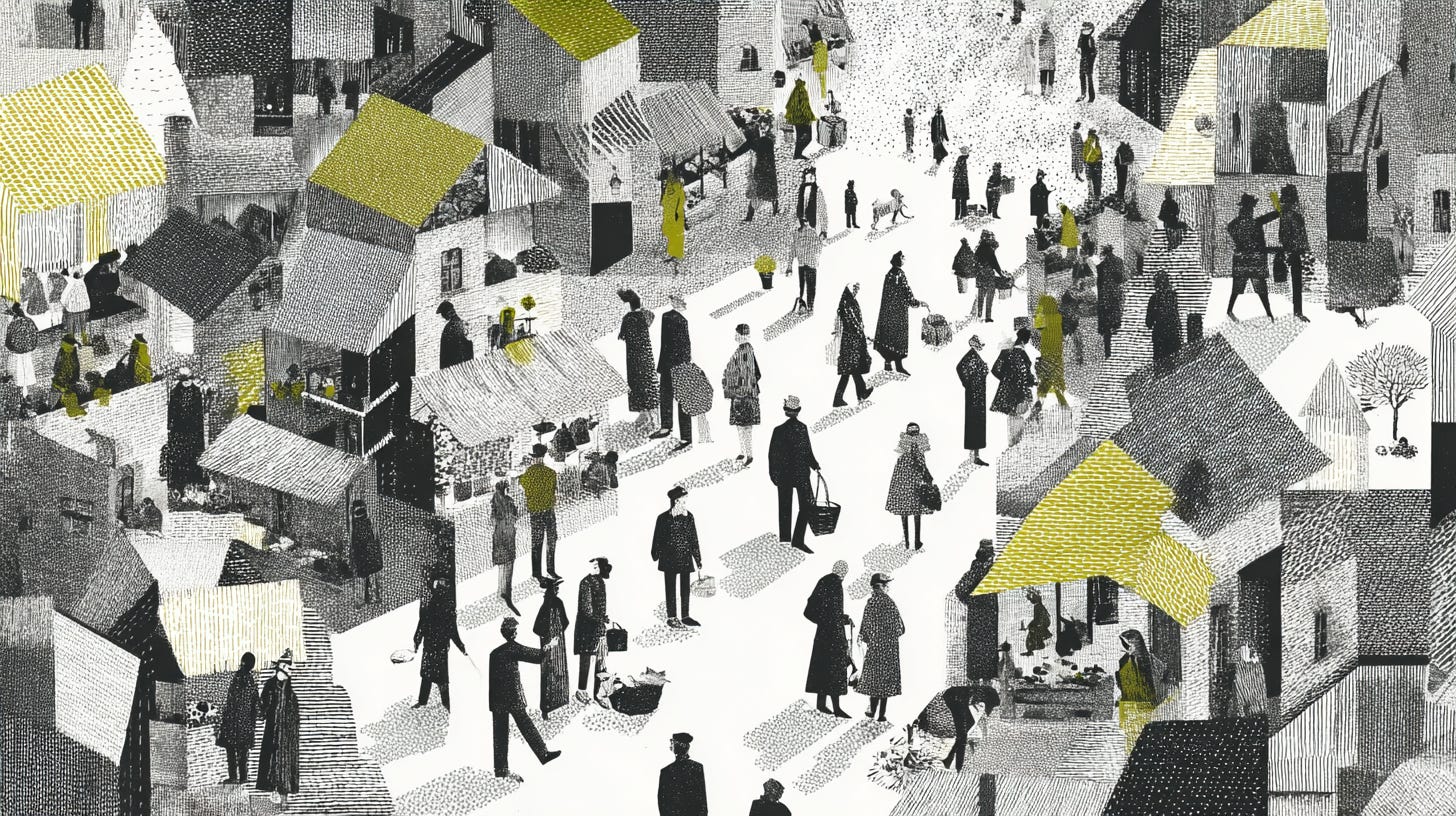
Under any form of governmental rule, including a democracy, the “ruling class” (politicians and civil servants) represents only a small proportion of the total population. While it is possible that one hundred parasites may lead a comfortable life on the products of one thousand hosts, one thousand parasites cannot live off of one hundred hosts.
Hans-Hermann Hoppe, Democracy: The God That Failed
Free markets are the path to long-term economic growth. And economic growth isn’t just good for Wall Street—it enables ordinary people to access more of virtually everything they care about, such as nutrition, medical care, safety, education, better job opportunities, and the rest of what constitutes material prosperity.
Moderate defenders of free markets are happy to acknowledge this for many purposes. For example, they understand that food was more widely available in the United States than in the Soviet Union because the Soviet communists interfered more with market forces on food production than US capitalists did. But moderate defenders of free markets, and people who are entirely against free markets, often doubt whether pure free markets would be a good idea.
While many societies on Earth today contain significant free-market elements, none of them are pure free markets, or purely any other one system of political economy. They have elements of free-market capitalism mixed in with some socialist policies, and so on. Pure free markets would entail radical reforms such as the complete elimination of taxation, since taxation is an involuntary forfeiture of private assets and therefore constitutes a violation of the private property rights that define the free market capitalist system. Radical libertarian economist Murray Rothbard proposed a “non-aggression principle” whereby “no man or group of men may aggress against the person or property of anyone else,” except in defense against those who have already initiated such aggression. This standard, constantly breached to a greater or lesser extent by every national government currently existing on Earth, is essentially what a society would have to uphold in order to count as a fully free market.
Critics of radical freedom and private property rights often ask: “If pure free markets would work so well, why don’t we see any national-scale examples in the real world?” It is a valid question. If reducing taxation and other infringements on private property rights to zero could make an economy vastly wealthier, as is the prediction of radical capitalists such as myself, wouldn’t we see at least one country take advantage of this opportunity?
The Direction of Causality Between Wealth and Parasitic Governance
One tempting answer is that taxation and other rights-violating institutions must somehow contribute to prosperity, since they are present in all wealthy societies. But this inference is not as strong as many assume it to be. As George Mason University economist Bryan Caplan has suggested, “Perhaps rich societies have big governments because it takes a colossal host to sustain colossal parasitism.”
Similarly, all healthy adult elephants have parasites but that doesn’t mean the parasites are making them healthier. The fact that parasitic institutions can persist does not mean they are beneficial any more than the presence of parasites on a healthy organism implies that the parasites are helping it. It simply means that the cost of eliminating such institutions is high, and that they are able to sustain themselves on the surplus generated by productive activity.
Instead of tax-collection enabling governance that makes societies rich, it is plausible that wealth generated through voluntary exchange creates an attractive target for political extraction. The presence of large governments in wealthy societies may reflect not their necessity, but their ability to feed on existing prosperity without immediately destroying it. This is a plausible explanation for why we do not observe national-scale pure free markets, even if government infringements on free market principles hinder rather than aid human wellbeing.
Historically, states have emerged not as the result of careful institutional design aimed at maximizing prosperity, but through conquest, coercion, and the gradual development of ideological justifications for rule. Once established, they persist by extracting resources from productive populations, often while convincing those populations of their legitimacy or necessity.
Prospects for the Future of Free Markets
Even if tax-funded institutions are merely parasitic, that doesn’t mean they’re all equally detrimental to human flourishing. Some are far less destructive than others, partly due to institutional tendencies toward self-restraint that some exhibit far more than others. Institutional self-constraints can raise the cost of coercion and lower the tolerance for rights violations, thereby reducing the scale of parasitism even if they do not eliminate it entirely.
For example, the First and Second Amendments of the United States Constitution make it harder for members of the federal government to infringe upon the speech, property, and association of US citizens. Though US statists still sometimes get away with it, the added cost of having to face constitutional backlash for infringements on free speech reduces such infringements at the margins. Even if marginal, such institutional constraints enable higher levels of innovation, productivity, and material prosperity than would exist under less scrupulous parasitic institutions.
Just because there has never been a national-scale experiment in pure free markets doesn’t mean that one can’t exist in the future. Slavery was omnipresent in every major society throughout most of recorded history, but in the post-Enlightenment world it was abolished in most societies thanks largely to conscious efforts beginning in Britain and other parts of the Western world. This happened extremely quickly relative to the grand sweep of human history. In the United States just a few years before the Civil War, abolition was widely considered extremely unlikely (when it was considered at all) and abolitionists were seen as fringe radicals. The institutionalized mass theft known as taxation could similarly fall away and become largely unthinkable to advanced societies.
But even if taxation and other widespread parasitic policies are never abolished, diminishing them at the margins is feasible and meaningful. By analogy, the idea of completely eliminating murder or rape from a society is unrealistic, but we do not conclude from this that efforts to reduce them are worthless or futile. Social norms, legal institutions, and cultural attitudes can significantly reduce the prevalence of such behaviors, even if they cannot eliminate them entirely.
Parasitic institutions such as taxation may likewise be difficult to eliminate completely, but they can be constrained, reduced, and delegitimized over time. And to the extent that this occurs, societies can move closer to a system of fully voluntary exchange, with corresponding marginal but meaningful gains in prosperity and human flourishing.