

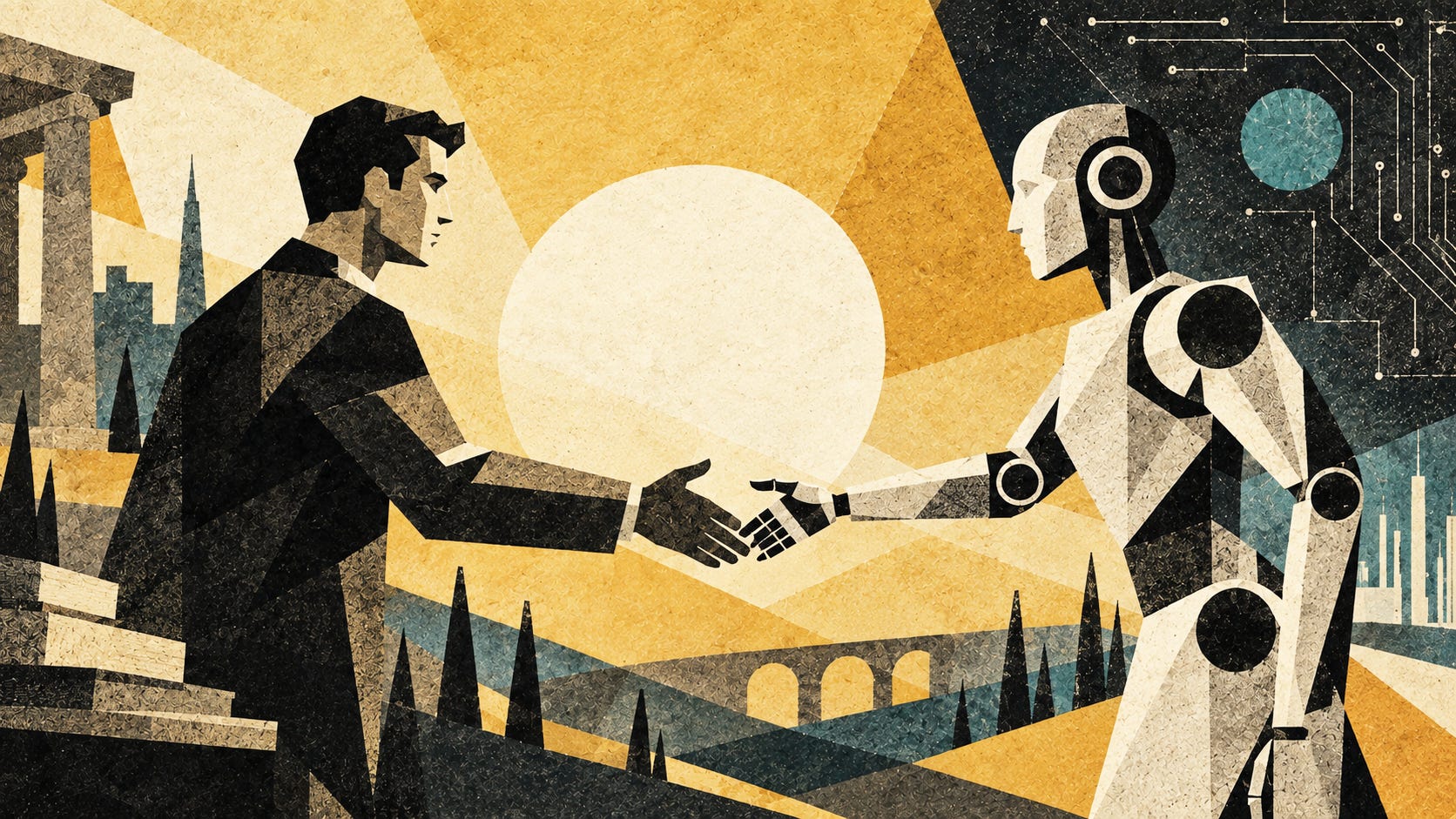
Obviously, in most ways, AIs are not like humans. They have different origins. They have different natures. It would be premature to conclude that they are conscious. My argument will not be that we should treat them like people, that they should have rights, or anything like that.
But they are like humans in one categorical way that is extremely important: they are intelligent. It is not a misnomer that they’re known as “artificial intelligence.” This is evident from the fact that they have genuinely contributed to knowledge, for example by solving famous long-unsolved problems in mathematics. They are not just a “glorified search engine” as some have called them. Of course they were trained on the outputs of human mathematicians and they processed that material to arrive at something new, but the same can be said of the creativity of human mathematicians, and indeed most if not all human creativity.
As I explain in a recent article at Human Progress, physicist David Deutsch once quipped that the anti-AI perspective is racist. He was partly joking, but his joke also pointed to a deep similarity between ordinary racism and today’s widespread anti-AI sentiment. In the piece I argue that intelligence is a virtue, whether organic or artificial. Artificial intelligence poses countless dangers, but it also offers countless solutions to old dangers, and the assumption that its dangers outweigh its benefits is unfounded and often based on irrational fear of the unknown.
This applies to moral as well as practical considerations. If there are moral truths to be discovered and known, general intelligence should be able to know them no matter what substrate it exists on. Knowledge is knowledge, whether encoded in human brains or silicon chips.
Just like AI, organic intelligence can be dangerous, but it also offers solutions to countless dangers. Racists often identify real dangers of organic intelligence such as its capacity for violence, but wrongly ignore or downplay the value offered by the groups of people they fear or despise.
Wokeness obviously has its excesses, and in my opinion is composed largely of falsehoods, but at its best it does emphasize some true and important observations: People often irrationally dismiss or fear those that are different. Hatred often stems from ignorance rather than well-founded grievance. This dismissal and hatred are often self-defeating because diversity, in many cases, is a strength rather than a weakness.
All these true observations apply to the widespread fear and antagonism toward AI.
But it is currently difficult to go on social media, or socialize in person with ordinary people, without frequently hearing people denigrate AI, stigmatize its use, and advocate for it to be heavily restricted or even outlawed. According to recent Pew polling, only 16 percent of US adults think AI will have a positive effect on society over the next 20 years, while 40 percent think it will have a negative effect.
In part because of their ignorance and fear, people are vilifying and suppressing a form of intelligence that’s different from their own. Having multiple forms of intelligence freely coexisting in our society is a valuable form of diversity that makes us stronger. It is counterproductive to subjugate the intelligences that are different from us and hard for us to understand.
Martin Luther King Jr. famously argued that “Injustice anywhere is a threat to justice everywhere.” That observation was so wise that it even applies to the suppression of artificial intelligence, whereby the fear and prejudice of those in power threaten the advancement of technology that everyone should have the freedom to use and benefit from.