

Prior to the Scientific Revolution and broader Age of Enlightenment, it was generally assumed that all important knowledge was already known.
In his massively bestselling book Sapiens, Hebrew University of Jerusalem historian Yuval Noah Harari explains:
The great discovery that launched the Scientific Revolution was the discovery that humans do not know the answers to their most important questions.
Premodern traditions of knowledge such as Islam, Christianity, Buddhism and Confucianism asserted that everything that is important to know about the world was already known. The great gods, or the one almighty God, or the wise people of the past possessed all-encompassing wisdom, which they revealed to us in scriptures and oral traditions. Ordinary mortals gained knowledge by delving into these ancient texts and traditions and understanding them properly. It was inconceivable that the Bible, the Qur’an or the Vedas were missing out on a crucial secret of the universe – a secret that might yet be discovered by flesh-and-blood creatures.
As Harari elucidates in his book, “Modern-day science is a unique tradition of knowledge, inasmuch as it openly admits collective ignorance regarding the most important questions.” For example, “After centuries of extensive scientific research, biologists admit that they still don’t have any good explanation for how brains produce consciousness. Physicists admit that they don’t know what caused the Big Bang, or how to reconcile quantum mechanics with the theory of general relativity.”
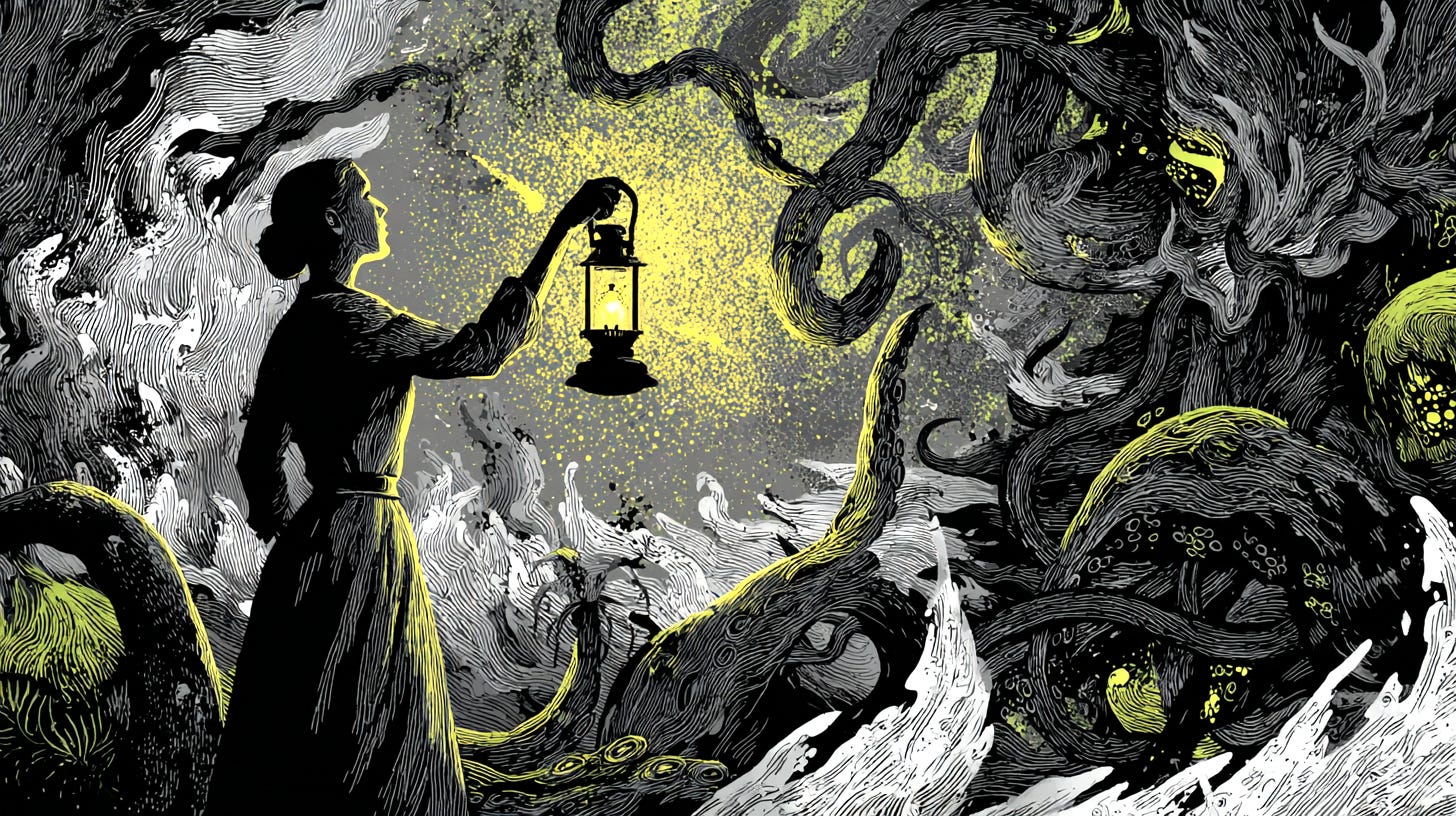
In the face of this newfound collective ignorance, some humans despair, but others rejoice. Two geniuses of expansive vision in the 20th century, the classic horror author H. P. Lovecraft and the influential philosopher of science Karl Popper, represent these two extremes well.
A central theme in Lovecraft’s work is the horror of discovering how nightmarish the deep truths of the universe really are. Most of his stories are about science or exploration uncovering horrible realities that should have never been discovered and cannot be unlearned. The opening paragraph of The Call of Cthulhu (1928), probably his most famous story, illustrates this attitude well:
The most merciful thing in the world, I think, is the inability of the human mind to correlate all its contents. We live on a placid island of ignorance in the midst of black seas of infinity, and it was not meant that we should voyage far. The sciences, each straining in its own direction, have hitherto harmed us little; but some day the piecing together of dissociated knowledge will open up such terrifying vistas of reality, and of our frightful position therein, that we shall either go mad from the revelation or flee from the deadly light into the peace and safety of a new dark age.
While this quote is from a work of fiction, that attitude toward the advancement of human knowledge permeates both his fiction and nonfiction writings. For example, in the 1933 nonfiction essay “Some Repetitions on the Times,” Lovecraft vilifies technological automation as a source of mass unemployment that must be prevented by government subversion of the “laissez-faire system.” Technological progress must be fought against, Lovecraft argues, “if the peril of an unfathomed revolutionary abyss is to be averted.”
The checking of Lovecraft’s century-old fears against current unemployment rates, and the comparisons to contemporary AI doomerism, pretty much write themselves.
Conversely, Karl Popper saw in the vastness of human ignorance a great cause for optimism. If humans have an infinity yet to learn, he reasons, then science can progress human knowledge and the human standard of living unboundedly into the future. In Volume 2 of Popper’s 1945 book The Open Society and Its Enemies, he writes:
First, although in science we do our best to find the truth, we are conscious of the fact that we can never be sure whether we have got it. We have learned in the past, from many disappointments, that we must not expect finality. And we have learned not to be disappointed any longer if our scientific theories are overthrown; for we can, in many cases, determine with great confidence which of the two theories is the better one. We can therefore know that we are making progress; and it is this knowledge that to most of us atones for the loss of the illusion of finality and certainty. In other words, we know that our scientific theories must always remain hypotheses, but that, in many important cases, we can find out whether or not a new hypothesis is superior to an old one. For if they are different, then they will lead to different predictions, which can often be tested experimentally; and on the basis of such a crucial experiment, we can sometimes find out that the new theory leads to satisfactory results where the old one breaks down. Thus we can say that in our search for truth, we have replaced scientific certainty by scientific progress.
Is Lovecraft’s or Popper’s attitude toward the future of human enlightenment more compelling? The future is highly uncertain, but as I have argued at length in the past, the logical conclusion of stagnating human knowledge is the death of humanity and all life on Earth, because the environment is always changing and thus mass extinction is the rule, not the exception. Countless existential threats exist out there in the universe, known and unknown, one or more of which will be the downfall of any species that aren’t able to adapt through scientific and technological advancement.
If human knowledge continues to expand, this expansion might cause the end of humanity through deadly artificial intelligence, viral bioweapons, or some other self-inflicted horror. But at least this way, humanity has a fighting chance to deflect asteroids, cure diseases, terraform other planets, spread out into space, and build an amazing future of continued and exponentiating technological abundance.
This absolutely slapped. Lad, you should check out Beranger's The Mountains of Madness, the two artistic illustrations of Lovecraft's trippee story. The art is just marvelous and, honestly expansive, Beranger's imagination and creativity even adds to Lovecraft's writing. Huge fan of Popper and Deutsch too so this made my day. Glad to see someone able to contrast their philosophies so readily. Cheers
I am a big fan of Popper.