

In his 1997 paper “Invention and Rebellion” (revised in 1998), the Nobel Prize winning economic historian Joel Mokyr argues that the governing powers in society tend to oppose innovation and discovery. “Every act of major technological innovation, then, is an act of rebellion against conventional wisdom and vested interests, and thus will normally lead to some kind of resistance,” he writes.
The legendary venture capitalist Marc Andreessen makes essentially the same point in starker, if more hyperbolic, terms. “All new information is heretical by definition,” he says in a 2024 interview on the Joe Rogan podcast. He continues: “Any time anybody has a new idea it’s a threat to the existing power structure, so all new ideas start as heresies.”
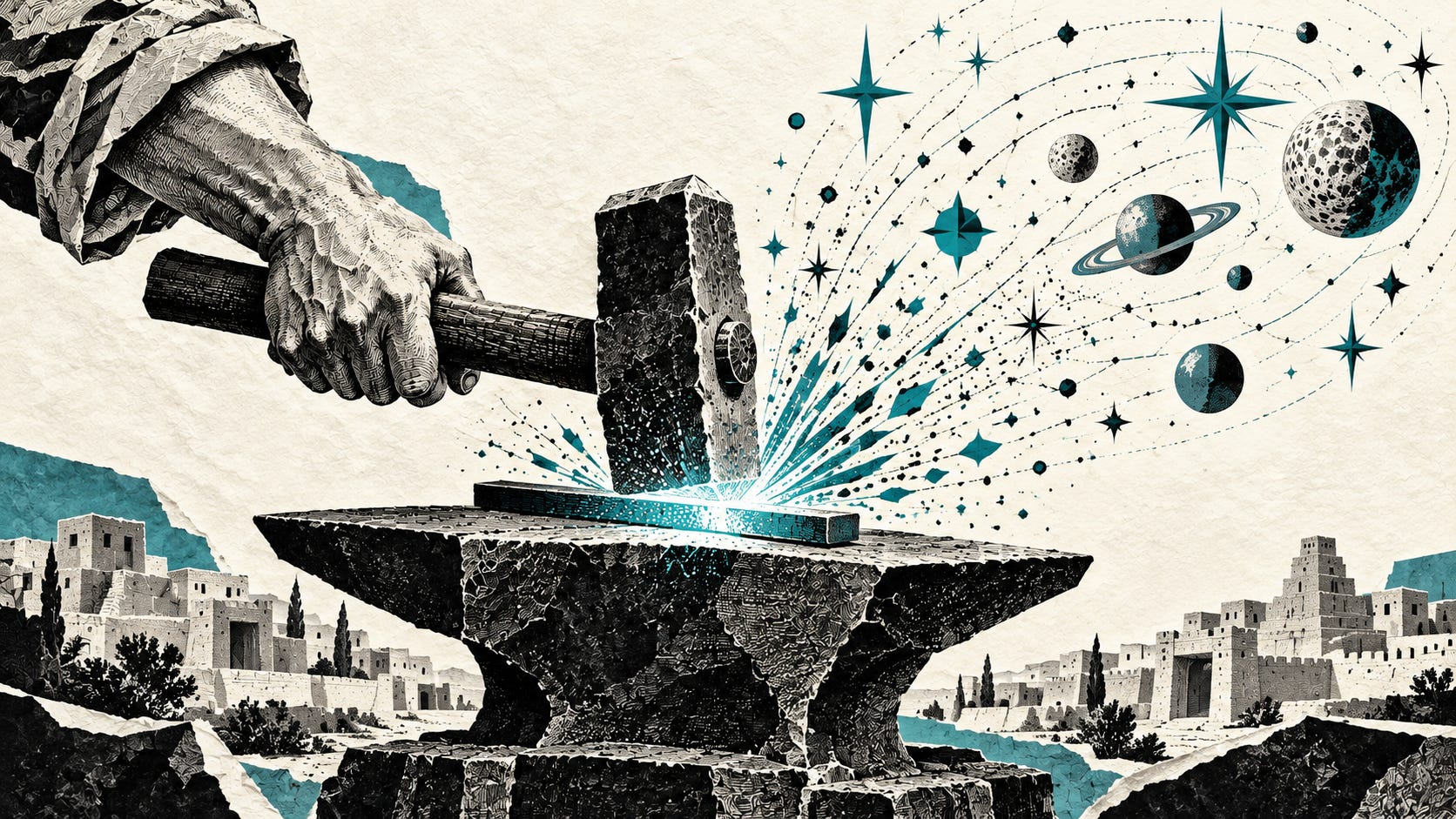
This pattern can be found all throughout history. Consider the shift from the Bronze Age to the Iron Age in the eastern Mediterranean. In a recent article titled “Why the Bronze Age collapsed,” economic historian Patrick Fitzsimmons argues that technological advancement played a central role in rendering the Bronze Age empires obsolete.
To produce the massive amounts of bronze required to arm imperial armies, tin and copper had to be collected and transported from disparate regions. The Hittite, Egyptian, and other Bronze Age empires, which controlled multiregional trade routes, relied on this fact for protection against uprisings by local political leaders.
The invention of bloomeries, the technology that enabled metallurgists to forge iron weaponry, decentralized the ability to forge viable military equipment. Consequently, Fitzsimmons writes, “The effects of iron were so stark that ancient writers in the subsequent centuries began separating human history into the bronze and iron eras.”
He goes on to explain:
These writers associated iron with war and decline; some also alluded to the idea that iron had democratized violence. The Hebrew Bible records that the Philistines attempted to limit access to smiths as they were worried others could easily make iron weapons. Lucretius describes the Bronze Age as a time when ‘naked men gave way to well-armed foes’ but said that iron made ‘the odds of war equal as they had not been before’. With the advent of iron, the cost of warfare fell: a king could not keep others from accessing a military technology found in local soils.
Fitzsimmons also argues that this shift reflects a broader pattern in history:
History has seen the ebb and flow of centralized and decentralized technologies of warfare ever since. Castles allowed barons of medieval Europe to subjugate the peasantry while also contending with their kings, until the gunpowder revolution eventually made castle walls obsolete. Gunpowder led to firearms, which strengthened states while they were new, scarce, and expensive, but then became cheap and easily accessible in the nineteenth and twentieth centuries, shifting power to peripheral groups of soldiers and rebels. On the world stage, nuclear weapons have massively increased the costs of one country invading another; for a small state, achieving nuclear status can be a powerful equalizer. With each development, the balance of power shifts.
Sometimes ascendent power structures do support efforts of discovery and innovation, despite the associated risks to the status quo, but even the most famous cases of this are often not as clearcut as they seem. The early modern European heads of state that helped spearhead the Age of Discovery and Scientific Revolution are a good example.
At that time, it was far from obvious that European political leaders had a firm grip on power given the constant conflicts between them. “Western Europe overtook China partly because in the West there was more competition in both the political and the economic spheres,” historian Niall Ferguson writes in his New York Times bestselling 2011 book Civilization: The West and the Rest.
Western European heads of state probably considered it extremely risky to fund the scientific and geographic discoveries that happened within their regimes, but in the disparate struggles between them it was existentially necessary to make long-shot wagers for geopolitical dominance.
Joel Mokyr makes essentially the same case in his 2017 article “How Europe became so rich.” He argues that it was the political fragmentation in Europe, not political hegemony, that led to investment in the discovery of new knowledge. “In brief, Europe’s political fragmentation spurred productive competition,” Mokyr explains. “It meant that European rulers found themselves competing for the best and most productive intellectuals and artisans.”
This sort of competition, with its definitionally undetermined outcomes, is exactly the sort of thing that heads of power structures need to avoid. To the extent that you’re in competition with opposing forces, your hegemony is already up for grabs. And that is the environment in which those at the tops of power hierarchies are forced to accept risk, and thus the growth of knowledge is able to flourish.