

One of the most famous arguments in Christian apologetics is Pascal’s Wager. Pascal writes in his posthumously published 1670 book Pensées (as translated by W.F. Trotter), “Let us weigh the gain and the loss in wagering that God is. Let us estimate these two chances. If you gain, you gain all; if you lose, you lose nothing. Wager, then, without hesitation that He is.” (The subsequent pages go into more detail about the decision theory of the wager, but I will not belabor the technicalities here.)
This argument was revolutionary because, while acknowledging uncertainty as to the truth of God’s existence, it attempted to make an expected value calculation to manage the risk of being wrong about God. Having co-invented modern probability theory in correspondence with Pierre de Fermat about 14 years earlier, Pascal was the first to explicitly apply the mathematics of expected value to moral decision-making. Such reasoning is now commonplace in moral philosophy.
Pascal’s Wager is widely considered by atheists, as well as many theologians, to be refuted. Some theologians will defend it, but it is less ubiquitous than arguments such as the cosmological argument and the teleological argument.
A key objection to the argument is the “many gods objection.” This is the objection that Pascal’s Wager rests on the false dichotomy of nihilism and a particular conception of God. If those are the only two possibilities, then you should bet on God if you can, because you have nothing to lose and everything to gain. But obviously there are infinite other possibilities as well, all of which have their possible negation. To cite just two examples, Conservative Evangelical Protestant Christianity and Ash’ari Sunni Islam each have conflicting doctrines. If one is true, paradise awaits its adherents and Hell awaits adherents of the other, and vice versa. And those are just two of infinite conflicting possibilities.
Therefore, Pascal’s critics argue, the wager argument could lead you to bet on infinite different doctrines, and to make matters worse each bet would also be a bet against your doctrine’s theoretical negation, and so the wager gets you nowhere.
This criticism is true as far as it goes, but stopping the analysis there misses out on a valuable element of Pascal’s argument. Pascal was trying to solve a real problem that, for many, remains unacknowledged: you have no choice but to wager on uncertain moral doctrines. Responding to the argument that you are less likely to lose if you refrain from wagering at all, Pascal points out, “Yes, but you must wager. It is not optional. You are embarked. Which will you choose then?” To refrain from wagering, fallible beings would have to pause the passage of time, and even then they would only be delaying the impending wager on how best to spend the resources of their life.
Given this necessity to wager, paired with the seemingly paralyzing “many gods objection,” what is there to do?
To answer that, it must be noted that the wager is not just a one-time thing. Every moment of action or inaction is a new wager. In other words, after this moment’s wager, you’ll almost always get another chance to wager.
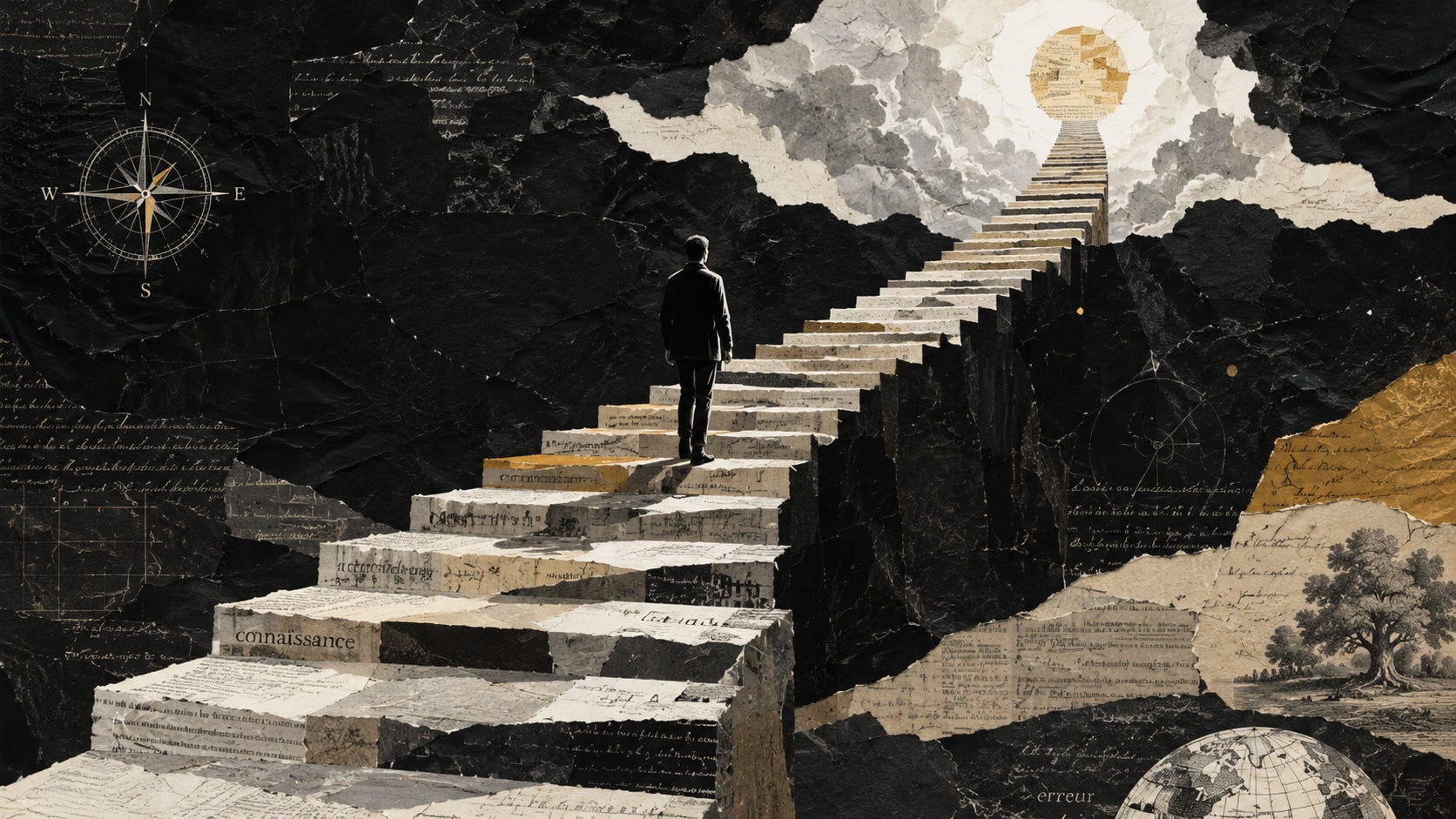
Given that context, all doctrines are not equal. Some moral doctrines, or “gods,” if you like, improve the wagerer’s chances in future wagers, while others diminish them. They do this by increasing or decreasing the wagerer’s body of knowledge, equipping them with a better or worse basis on which to place wagers.
The wager can improve the wagerer’s future odds through direct knowledge acquisition, but also through indirect positioning improvements. For example, working a lucrative job or making financial investments often provides direct improvements to the wagerer’s understanding of the world, but increased financial prosperity also indirectly increases the wagerer’s expected all-time knowledge set by increasing the sustainability of their life and therefore giving them more time, resources, and stability for future knowledge improvements.
No two doctrines will virtually ever be equally conducive to the long-term growth of knowledge. For example, even if we have equal credence in the truth value of Christianity and Islam, one of these sets of doctrines will be more conducive than the other to human flourishing, to the continued pursuit of truth, to sustaining human civilization. And in this manner all competing doctrines can theoretically be placed on a hierarchy from most to least conducive to the continued improvement of knowledge. Whatever is at the top of that hierarchy is what Pascal should have wagered on, and what we should wager on now.
With the complex doctrines that enjoy widespread adherence today, such as Christianity and Islam, it is difficult to determine which are more or less conducive to the growth of knowledge. While it seems that Christianity (with its mandate to “render unto Caeser” and so on) generally beats Islam (with its doctrines of Sharia, Jihad, and so on), this is a topic for historians, theologians, psychologists, and economists to debate. Even harder are the more granular debates, such as those about Catholicism versus Protestantism, Sunni versus Shia, and so on.
But one thing is clear: we can posit a theoretical doctrine, “knowledge maximalism,” and know that this is the doctrine that we should wager on. We are then left with the hard work of figuring out how best to maximize knowledge. Is capitalism or socialism more conducive to the long-term maximization of knowledge? What about veganism or meat eating? Lying to our wives or being honest with them? And so on.
While Pascal’s Wager is flawed because it presupposes a particular conception of the ultimate good, this new “knowledge maximalist’s wager” does not attempt to specify the correct payoff function in advance. Instead, it seeks to improve the wagerer’s capacity to evaluate and pursue whatever payoff function would ultimately prove most compelling. While never explained quite this way during the 18th century Age of Enlightenment, I believe this was a core element of the Enlightenment meta-ethic. Enlightenment thinkers disagreed strongly about the nature of morality. Bentham favored maximizing utility, while Kant defended his categorical imperative, and so on. But they were all part of the “Enlightenment” because they perpetuated the ethos that treats such theories as fallible and subject to potential improvement, and bets that the process of expanding human knowledge will improve the expected value of such theories generally.
If we make an effort to live in such a way that our body of knowledge is improving to the greatest and most sustainable extent possible, we will be maximizing our chances in the continuous moral gambling necessitated by living a fallible life.
Brilliant. So many gems are discarded because one aspect is refuted. Loved your exploration of the enduring utility of Pascal’s wager.
You lost me on this one. I'm not so sure about even the very restricted elements of certainty you end up with here.
What if, for example, a version of the Hindu notion of "maya" is the nature of reality? It COULD be that all of what we can perceive and measure in this "reality" is illusion, and that all the time we spend analyzing it, and all the "gain" we experience by accumulating knowledge about it is actually "loss," as it distracts us further and further from the "true reality," which can only be accessed or known by the paradoxical step of stepping out of all "knowledge" and illusion. There are variations of this possibility in which even spending time gambling on the race is actually a loss rather than a gain, or at least completely irrelevant.
Or, what if the "we" who are (individually or collectively) betting on these horses are by our very existence a net loss in the larger web of life and reality? (A virus, perhaps, as Agent Smith refers to humans in The Matrix). It's possible that even if continuing to learn and collect knowledge is good for "me" as an individual, or good for "us" as a tribe/country/species, that it only seems that way to us, from our selfish (anthropomorphic) point of view. It could be that we live in a universe that would actually be better off without us continuing down this path of maximizing knowledge/ourselves.
Dark, I know, but possible.