

As strange as this sounds, the assumption of ordinary pre-modern people tended to be that all the important knowledge of the universe was already known. It doesn’t seem to have occurred to them very often that there might be an undiscovered continent across the ocean, or an unimagined law of nature that explains the rise and fall of the tides, or some amazing future ship design just waiting to be invented.
Of course there were short-lived exceptions in parts of ancient Greece, Medieval Europe, and elsewhere throughout history, but none sweeping enough until the 16th century to constitute a broad Scientific Revolution.
The pre-scientific mindset is hard to imagine for modern people born into a new paradigm wherein the vastness of humanity’s ignorance is freely acknowledged. Today’s experts in virtually every field tend to openly admit massive gaps in knowledge at the frontiers of their fields. Indeed, the more big unanswered questions, the more grant money there is to be collected. Physicists admit the veracity of string theory, the reconciliation of general relativity and quantum mechanics, and the true explanation of the big bang are open questions. Biologists admit that human longevity is amenable to pharmacological intervention to an extent yet to be determined. AI researchers admit they don’t know what it will take to make AI conscious, whether AI is already conscious, or whether it will never be conscious. Many of these people have their favored answers to these questions, but most will admit that nobody knows for sure.
The Scientific Revolution of the 16th and 17th centuries was, among other things, the discovery of ignorance. That is how the Hebrew University of Jerusalem historian Yuval Noah Harari describes it in his massively bestselling 2011 book Sapiens: A Brief History of Humankind. He writes:
The great discovery that launched the Scientific Revolution was the discovery that humans do not know the answers to their most important questions.
Premodern traditions of knowledge such as Islam, Christianity, Buddhism and Confucianism asserted that everything that is important to know about the world was already known. The great gods, or the one almighty God, or the wise people of the past possessed all-encompassing wisdom, which they revealed to us in scriptures and oral traditions. Ordinary mortals gained knowledge by delving into these ancient texts and traditions and understanding them properly. It was inconceivable that the Bible, the Qur’an or the Vedas were missing out on a crucial secret of the universe – a secret that might yet be discovered by flesh-and-blood creatures.
In the old days, if a piece of information was left out of the traditional teachings, that just meant it wasn’t important enough for God to have bothered mentioning. People knew they could not look in the Bible and find out how many hairs grow on a hog’s back, but they took that as evidence of the triviality of that information. If the answer were really important, it would be in there somewhere.
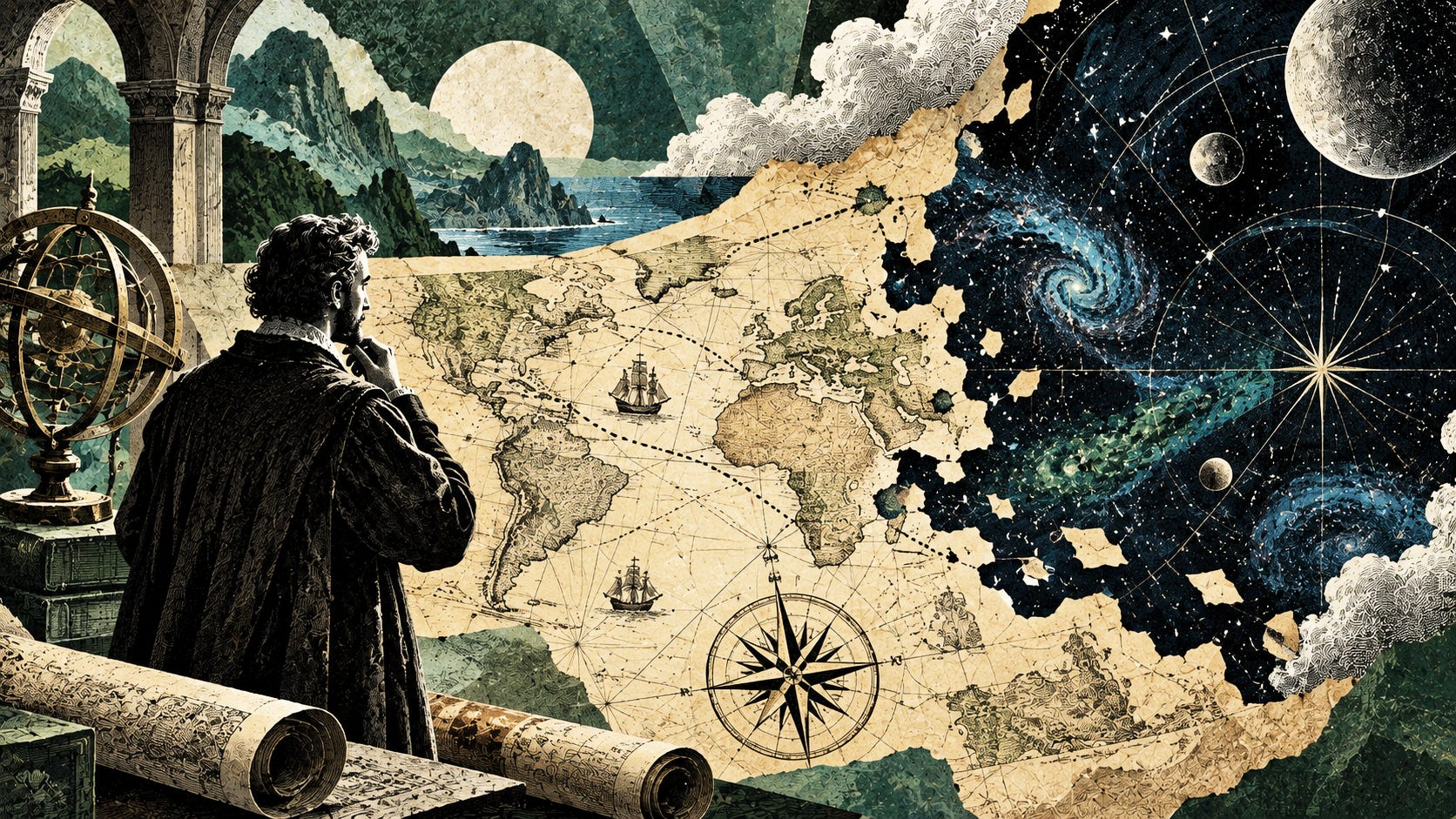
One clear window into the pre-scientific mindset comes from studying old maps. Although pre-scientific people had not explored all the lands of the earth, their maps often falsely suggested a complete understanding of geography. Harari shows examples in his book to illustrate this, and writes:
Many cultures drew world maps long before the modern age. Obviously, none of them really knew the whole of the world. No Afro-Asian culture knew about America, and no American culture knew about Afro-Asia. But unfamiliar areas were simply left out, or filled with imaginary monsters and wonders. These maps had no empty spaces. They gave the impression of a familiarity with the entire world.
During the fifteenth and sixteenth centuries, Europeans began to draw world maps with lots of empty spaces – one indication of the development of the scientific mindset, as well as of the European imperial drive. The empty maps were a psychological and ideological breakthrough, a clear admission that Europeans were ignorant of large parts of the world.
There were proto-scientific traditions such as medieval alchemy and astrology that acknowledged the ignorance of their societies, but even they mischaracterized and understated the extent of that ignorance. “They searched for a secret which, they believed, had once been known in antiquity but had later been forgotten,” the great philosopher of science Karl Popper explains in his 1994 book The Myth of the Framework. “They looked for the key to wisdom in old parchments.”
In the old days, sometimes someone did manage to challenge the intellectual status quo, but generally by converting followers to a new claimant on infallible authority. The prophet Muhammad is a good example: he converted thousands of believers to a new way of thinking, but the new doctrine was just as dogmatic and epistemically totalitarian as the old. It didn’t say “the old religion lacks some important knowledge, and so do we.” It said “the old religion lacks some important knowledge, but this new one has all the answers.”
Far more often, challengers to entrenched worldviews failed to attract anything like Muhammad’s following. They were typically persecuted for heresy, treated as mad, or ignored if they were lucky.
In this environment, not only was the pursuit of new knowledge a dangerous endeavor that could get you killed or exiled by the powers that be, but it also seemed relatively pointless. Why look to discover new things or contemplate the unknown if all the important truths were already possessed?
Only in the revolutionary context of widely acknowledged ignorance does advancing human knowledge seem possible and desirable to normal people. And only in that context would you go to great lengths to test a theory, rather than just assuming it to be true or false. It therefore was in this context that the rate and reliability of cumulative scientific improvement accelerated dramatically.
And that is what has happened on an unprecedented scale since the Scientific Revolution, as evidenced by the sudden explosion of technological capabilities that humanity has achieved since the Enlightenment and Industrial Revolution.