

You have probably often heard it declared that “there are no new ideas.” Less often is this proposition scrutinized.
One of the most famous modern formulations of the concept came in 1906-1907 from Mark Twain, who wrote, “There is no such thing as a new idea. It is impossible. We simply take a lot of old ideas and put them into a sort of mental kaleidoscope.” The sentiment has an ancient biblical precedent as well: Ecclesiastes declares that “there is no new thing under the sun.”
It is true that new ideas are hard to come by. When people reiterate the sentiment that “there are no new ideas,” they sometimes appear to mean it as a nonliteral rhetorical statement. Other times they seem to mean it literally. Whether these “Idea Pessimists” (as I will call them) mean the proposition literally or simply exaggerate to deemphasize the possibility and importance of new ideas, their claim is worth dissecting in detail. I think that despite their rarity, new ideas are so important that it is more cogent to stress their possibility than to state their impossibility.
Three Questions for Idea Pessimists
We are biased toward the supposed nonexistence of new ideas because if there are ideas yet undiscovered, they are invisible to us by definition. Ideas that we already know of must not be totally new. So, in any moment between new ideas being discovered, no new ideas appear to exist.
But even if no new idea had been thought of for a millennium, this might be because every new idea is well hidden. Calculus was only thought up after millennia of mathematical breakthroughs upon which it built, and so it has been for countless mathematical ideas since then. So perhaps the next idea will be even harder to discover, requiring billions of people and trillions of dollars in research funds to imagine.
With that in mind, I propose three questions for Idea Pessimists. Next time you meet one, I hope you ask these questions and get some clear answers.
Approximately when do you suppose the last new idea was discovered? Were there still new ideas in the Mesozoic era but not when Einstein published his theory of general relativity in 1915? Was Einstein’s theory just a retelling of ideas that cavemen or medieval people already had, or did the supply of new ideas dry up between then and now?
Suppose there are plenty of new ideas somewhere beyond the horizon, as there must have been for some earlier form of life, whether we have to go back to single-celled organisms or merely 19th-century humans. How would you know that all the new ideas had been taken? What makes you confident that no undiscovered ideas remain, when any such ideas would, by definition, still be unknown to you?
When someone first had the idea that “there are no new ideas,” was that the last new idea? Or was the first utterance of that declaration premature? If “there are no new ideas” was indeed the last new idea, it seems an amazing coincidence. But if that idea was discovered too early and thus initially inaccurate, why should we assume that we have since crossed over into an era in which the claim has become accurate?
In 1903, years before quantum field theory and the theory of general relativity revolutionized physics, the Nobel Prize-winning physicist Albert Michelson proclaimed, “The more important fundamental laws and facts of physical science have all been discovered, and these are now so firmly established that the possibility of their ever being supplanted in consequence of new discoveries is exceedingly remote.” He obviously underestimated the possibility that future discoveries would overturn what seemed to be firmly established fundamental principles. Countless brilliant people throughout history have made this mistake, and I submit that the Idea Pessimists of today are as well.
New Ideas Abound
Given the infinity of human ignorance, it is to be expected that countless new ideas await discovery. But in addition to that theoretical reason to suspect the availability of new ideas, we can see the frequent introduction of new ideas into daily life. For example, technological breakthroughs, which are happening every day, often entail specific new ideas that should not be discounted.
Specific technical ideas about exactly how to engineer and organize certain quantities and sets of materials were required for the invention of GPS systems, Adobe Photoshop, mRNA vaccines, ChatGPT, and countless other inventions. In each case, many old ideas were built upon, but earlier people did not know exactly how to build the new technology, because they all lacked the idea of how specifically to put it together. Those new specific ideas matter. They should not be trivialized to the point of dismissal.
Developing Adobe Photoshop required specific solutions to programming and design problems. Those solutions added knowledge even though they drew on earlier mathematics, software, and image-processing techniques. And the specific idea of how to make Adobe Photoshop is significant. It changes the world in ways never before seen by facilitating a new set of capabilities and events that can change the course of history, in ways small or large. The same is true of large language models and countless other technologies that nobody knew how to build until very recently.
Giving these specific and technical new ideas their due is important. If we go about convincing ourselves of the impossibility of new ideas, how much less motivated will we and our children be to invest in finding them? Searching for new ideas requires great research institutions and venture capital efforts and individual contemplation. These endeavors should not be preemptively denounced and disincentivized through declarations of categorical futility.
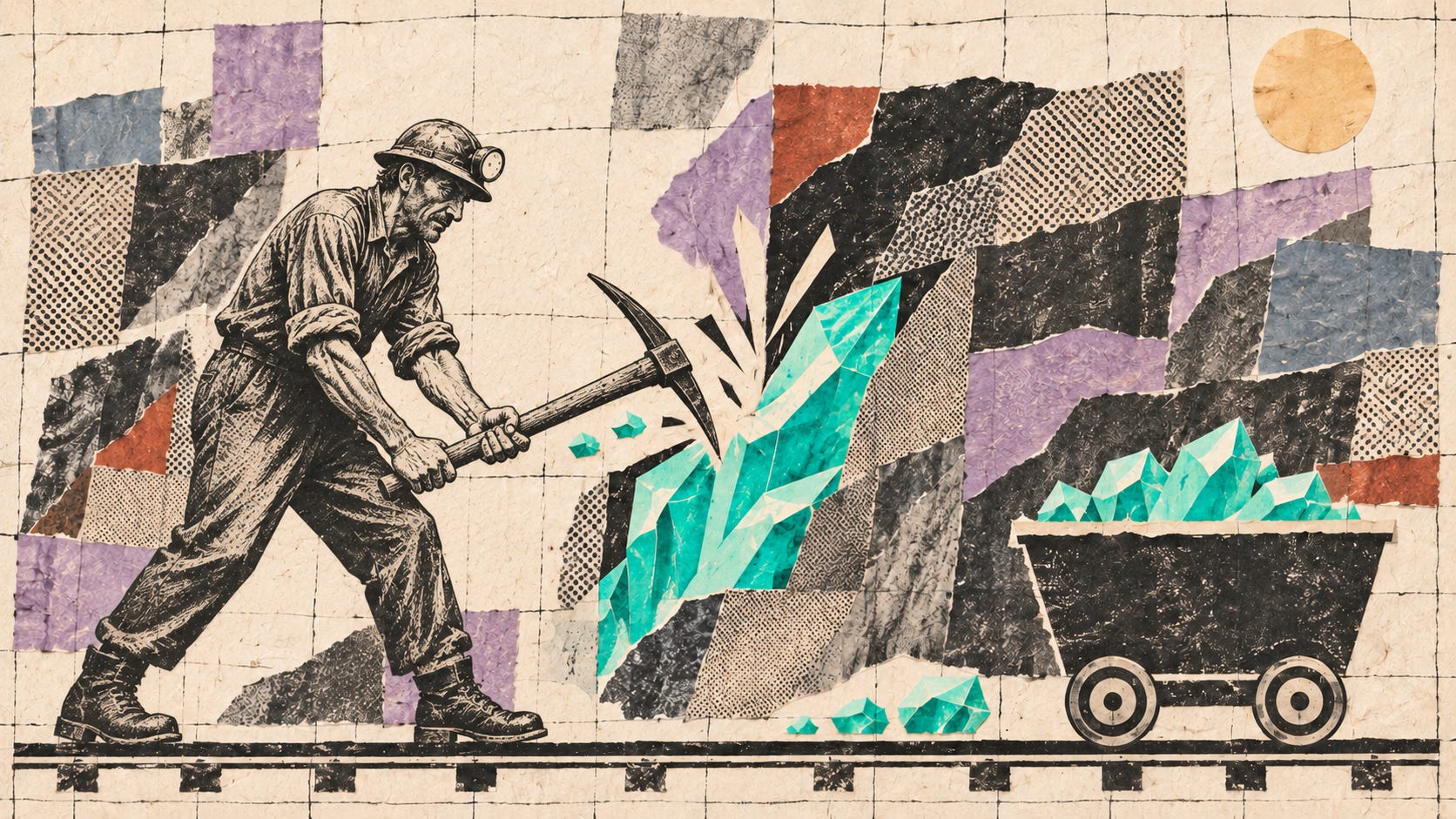
Even if new ideas are exceedingly hard to come by, perhaps they are so important that millions of careers and fortunes should be devoted to finding them. In that case, instead of declaring “there are no new ideas,” a better saying would be that “valuable new ideas are like gold mines—hard to find, but important and worth searching for.”