


This article was published at Human Progress on 6/24/2026.
In his 1942 novel Beyond This Horizon, the classic science fiction author Robert A. Heinlein explores the problem of nihilism or aimlessness that can befall a prosperous civilization. The cover of the book’s first edition reads, “The intriguing novel of a future Earth when science and technology have solved all problems – except the ‘why’ of life.”
This predicament of material prosperity combined with moral aimlessness is at least as resonant today as it was when Heinlein wrote in the mid-20th century. What some researchers describe as a “crisis of purpose,” as well as my own personal knowledge of many of my peers, suggests that many people in developed society struggle to find a strong basis for moral conviction. Some cannot accept theological dogmas themselves but hope for a religious revival to rescue civilization from encroaching nihilism. Some believe that humans must agree on a set of broad humanist morals even while admitting an inability to offer firm grounding for such morals. Others advocate and celebrate the abolition of moral norms and standards altogether.
Heinlein imagines a different path forward.
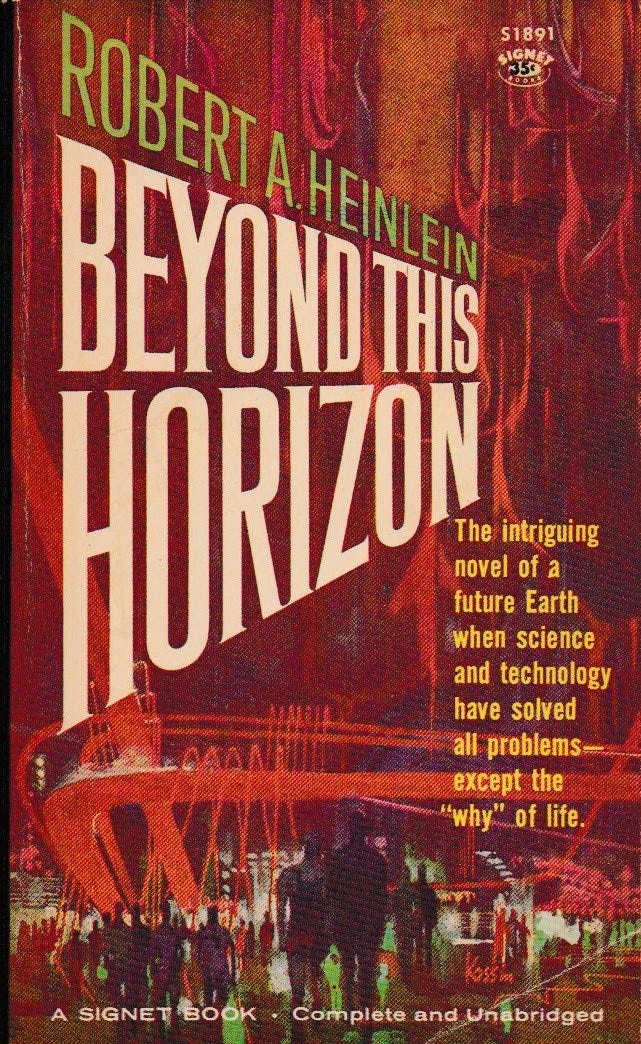
When Hamilton Felix, one of the main characters in Beyond This Horizon, is offered the opportunity to contribute to the human race’s sustained prosperity, he questions why he should bother. An official named Mordan explains to Felix that by participating in a largely costless program he can aid in humanity’s far-future survival, but Felix replies, “Even so, I know of no reason why the human race should survive... There’s no point to being alive at all. I’m damned if I’ll contribute to continuing the comedy.” After Mordan continues attempting to persuade him, Felix replies, “Survival! What for? Until you can give me some convincing explanation why the human race should go on at all, my answer is ‘no.’”
Later in the book, Felix is again called upon to hear out Mordan. This time, Mordan has devised a response to Felix’s question about the “why” of it all. “I don’t propose to give you an answer here and now,” Mordan admits. But he asks, “Would you be willing to cooperate if you knew that a serious attempt was being made to answer your question?”
Mordan explains that, “Such a research might not be completed in years, or in our lifetimes. But suppose I declare to you that such a research were to be attempted, seriously, hard headedly, all out, and no trouble spared, would you then consent to co-operate?”
I shall not needlessly spoil Felix’s response, except to give away that this “Great Research” does eventually begin, and the characters of the novel realize that its scope and scale must be very grand in order to rise to the vastness of the project of searching the universe for moral truth. The narrator explains:
The Great Research in its opening phases seemed to fall into half a dozen major projects, some of which interested him more than others because they gave some hope of producing results during his lifetime. Some, however, were almost as colossal as the building of the Grand Eidouranion. The distribution of life through the physical universe, for example, and the possibility that other, nonhuman intelligences existed somewhere. If there were such, then it was possible, with an extremely high degree of mathematical probability, that some of them, at least, were more advanced than men. In which case they might give Man a “leg up” in his philosophical education. They might have discovered “Why” as well as “How.”
This fictional “Great Research” project of an epistemically mature, non-dogmatic civilization bears striking resemblance to a real prescription from leading moral philosophers in the 21st century. The University of Oxford philosophers William MacAskill and Toby Ord, founders of the highly influential effective altruism movement, have advocated what is often called the “Long Reflection” (a term coined by MacAskill).
These philosophers admit that, relative to the grand timescale of human history, humanity may not have made much progress yet in developing robust moral theories. But rather than conceding to nihilism, they point out that moral questions may not be impossible to answer even if they are so difficult that little to no progress has yet been made. Moral philosophy may still be in its infancy, like physics before Newton or biology before Darwin. In 1790 Immanuel Kant famously declared that “there will never be a Newton of the blade of grass,” failing to imagine that something as chaotic and complex as biological life could ever be subjected to a rigorous scientific theory. Darwin arguably proved him wrong less than a century later, and likewise, some future moral theorists may prove the nihilists and dogmatists wrong in ways not yet conceived.
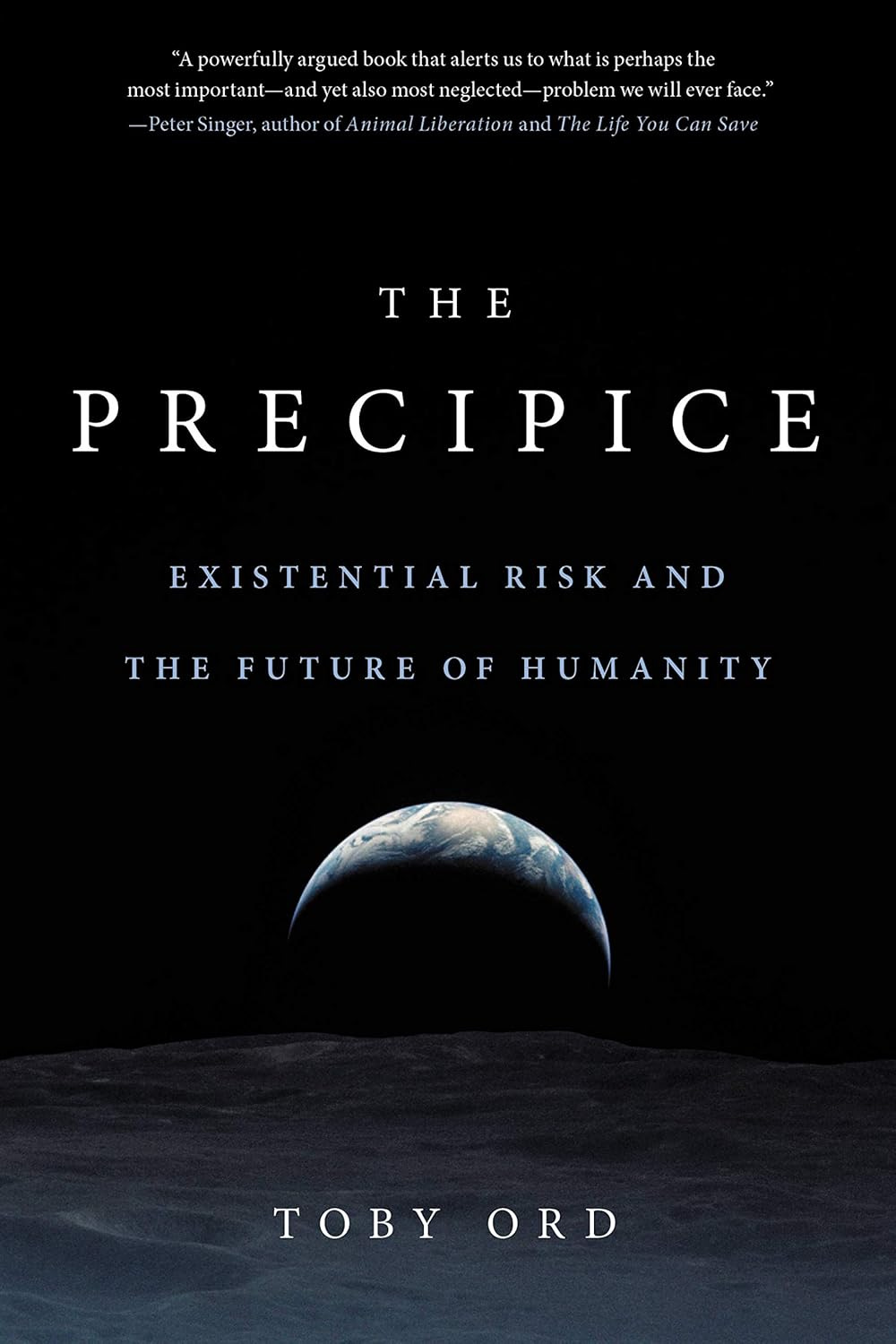
Thus, the Oxford philosophers propose the Long Reflection: a hypothetical period of centuries, millennia, or longer for humanity to investigate moral questions instead of calling off the search for moral truth. As Ord explains it in his 2020 book The Precipice: Existential Risk and the Future of Humanity:
During the Long Reflection, we would need to develop mature theories that allow us to compare the grand accomplishments our descendants might achieve with eons and galaxies as their canvas.
Present-day humans, myself included, are poorly positioned to anticipate the results of this reflection. But we are uniquely positioned to make it possible.
…
While moral philosophy would play a central role, the Long Reflection would require insights from many disciplines. For it isn’t just about determining which futures are best, but which are feasible in the first place, and which strategies are most likely to bring them about. This requires analysis from science, engineering, economics, political theory and beyond.
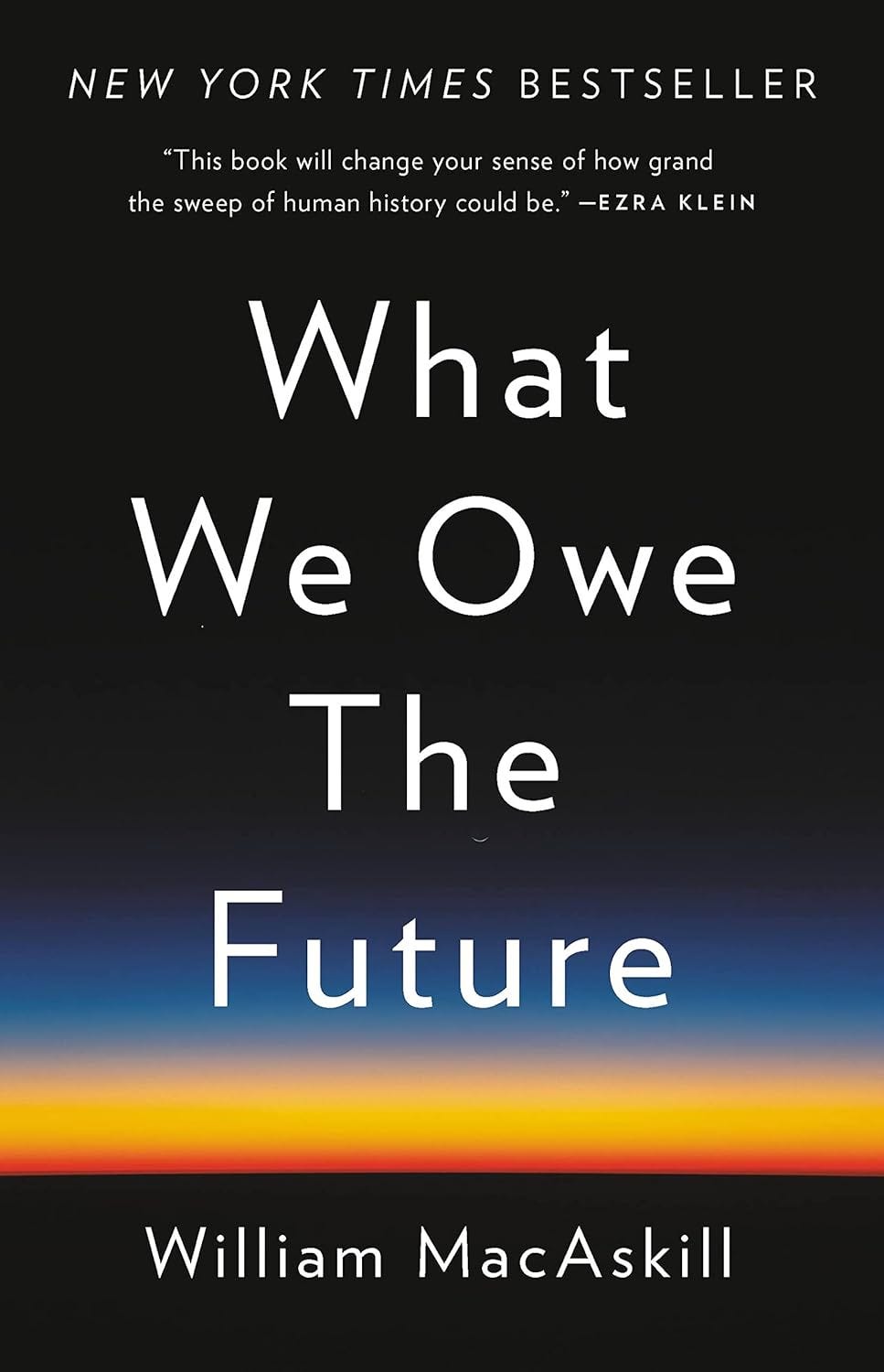
In his 2022 New York Times bestselling book What We Owe the Future, MacAskill elaborates:
I think we should accept that we don’t know what the ideal state would be; the primary question is how we can build a society such that, over time, our moral views improve… What we want to do is build a morally exploratory world: one structured so that, over time, the norms and institutions that are morally better are more likely to win out, leading us, over time, to converge on the best possible society.
As Heinlein depicts in his novel, and as Oxford philosophers Toby Ord, William MacAskill, and Nick Bostrom are now contending with, the post-Enlightenment scientifically sophisticated modern world is one in which no religious dogmas or naively adopted moral philosophies can be relied on to guide civilization. While plenty of radical sects still uphold their dogmas and fight for their causes, the baseline skepticism and belief siloing of the culture at large have become so strong that it is hard to imagine any one set of moral dogmas recapturing vast swaths of hearts and minds without a stronger philosophical basis than any already existing ideology has yet demonstrated.
But in such a society it is understood that the most important truths about the world are likely not yet discovered. Nihilism, like any other moral theory yet developed, should be considered too premature to win the day. Thus, epistemically mature society must not succumb to moral aimlessness. Rather, it must be devoted to the moral pursuit of expanding Enlightenment and expanding the scope and scale of human knowledge.
Outstanding, Saul. I have been thinking a LOT about this recently, and had no idea about either Heinlein's book or these Oxford guys -- thank you for connecting me with other people thinking about things that matter to me!