


As I explain in my recent article “The Scientific Revolution Was the Discovery of Ignorance,” people before the Scientific Revolution tended to assume that all important knowledge was already known. If they had a question that was left unanswered by their holy books or ancestral traditions, this was seen as evidence that the question was unimportant, not that the tradition was incomplete.
Only through the Scientific Revolution, which largely began in the 16th century, did it become broadly acknowledged in human society that humanity is ignorant of vast swaths of the workings of the universe, and that we can develop new conjectures and tests to improve our knowledge of important things.

But the discovery of ignorance did not stop with the physical sciences that were the subject of the Scientific Revolution. In 18th-century Europe and America, the broader movement known as the Enlightenment took the Scientific Revolution’s discovery of ignorance and applied it to human nature, society, and morality, using it to challenge faulty dogmas in countless areas of human life.
This broadening of the scope of admitted ignorance and thus open inquiry paved the way for societal progress and abundance like nothing the world had ever seen. The field of economics is a clear example.
In Europe prior to the Age of Enlightenment, economies were regulated on behalf of extremely restrictive and seldom-questioned dogmas. It was generally assumed, for example, that men should inherit the occupations of their fathers, so it was rare and often forbidden for men to enter the industry of their choice. Land ownership was usually limited to the small minority born as lords. Lending at interest was widely outlawed or heavily restricted, limiting credit and enterprise. Even personal style choices such as clothing and furniture styles were heavily regulated by sumptuary laws.
The Enlightenment challenged widespread assumptions that these norms were instituted by the divine order of things since time immemorial and that they were indispensable for holding spiritual and material life together. Enlightenment philosophers such as Richard Cantillon, and especially Adam Smith, who is often considered the founder of modern economics, made powerful cases that such strict economic regulations were based not on infallible ancient knowledge but rather on authoritarian epistemic hubris.
Smith realized that no central authority or wise tradition possessed most economically valuable knowledge. Rather, that knowledge was largely decentralized and ever-changing, and was discoverable by individuals throughout the economy. This meant that economic productivity could improve dramatically through the freeing of individuals to discover and monetize new knowledge.
Smith writes in book IV, chapter 2 of his 1776 work The Wealth of Nations:
What is the species of domestick industry which his capital can employ, and of which the produce is likely to be of the greatest value, every individual, it is evident, can, in his local situation, judge much better than any statesman or lawgiver can do for him. The statesman, who should attempt to direct private people in what manner they ought to employ their capitals, would not only load himself with a most unnecessary attention, but assume an authority which could safely be trusted, not only to no single person, but to no council or senate whatever, and which would nowhere be so dangerous as in the hands of a man who had folly and presumption enough to fancy himself fit to exercise it.
This revolutionary concept has since been sharpened and expanded by the work of many great economists. In his 1945 article “The Use of Knowledge in Society,” the Nobel Prize winner Friedrich Hayek explains that the free exchange of goods and services systematically reveals the highly precise and otherwise undiscovered economic knowledge that facilitates economic growth through better allocations of the world’s resources. In “The Use of Knowledge in Society” he writes:
Assume that somewhere in the world a new opportunity for the use of some raw material, say, tin, has arisen, or that one of the sources of supply of tin has been eliminated. … All that the users of tin need to know is that some of the tin they used to consume is now more profitably employed elsewhere and that, in consequence, they must economize tin. There is no need for the great majority of them even to know where the more urgent need has arisen, or in favor of what other needs they ought to husband the supply. If only some of them know directly of the new demand, and switch resources over to it, and if the people who are aware of the new gap thus created in turn fill it from still other sources, the effect will rapidly spread throughout the whole economic system and influence not only all the uses of tin but also those of its substitutes and the substitutes of these substitutes, the supply of all the things made of tin, and their substitutes, and so on; and all this without the great majority of those instrumental in bringing about these substitutions knowing anything at all about the original cause of these changes.
Later economists, most notably Julian Simon in his 1996 book The Ultimate Resource 2, have argued that the implications of humanity’s vast economic ignorance apply directly to the material world. While Hayek had argued that resource allocation is best determined through the constant discovery of economic knowledge, Simon explained that the very existence of resources, or the scarcity thereof, is a consequence of the presence or absence of human knowledge:
What is relevant to us is not whether we can find any lead in existing lead mines but whether we can have the services of lead batteries at a reasonable price; it does not matter to us whether this is accomplished by recycling lead, by making batteries last forever, or by replacing lead batteries with another contraption. Similarly, we want intercontinental telephone and television communication, and, as long as we get it, we do not care whether this requires 100,000 tons of copper for cables, or a pile of sand for optical fibers, or just a single quarter-ton communications satellite in space that uses almost no material at all. And we want the plumbing in our homes to carry water; if PVC plastic has replaced the copper that formerly was used to do the job—well, that’s just fine.
The set of what counts as a “resource” expands with the growth of knowledge because new knowledge leads to new ideas about how to use materials. This suggests that, since the growth of knowledge is unbounded as far as we know, so too is the growth of material prosperity. Hence Simon’s conclusion that “The frequent assertion that of course our resources are finite is quite inconsistent with the fact that present scientific knowledge of our physical world is extraordinarily incomplete (and probably always must be).”
The deployment of global capitalism since the Age of Enlightenment, while not yet completed because all industries and resources are not yet fully privatized, has already done a lot to unshackle industry and enterprise from the bonds of premodern dogma. This unshackling, the rise of the free market, has enabled so much economic discovery that global GDP per capita has unprecedentedly shot up.
Prior to the Age of Enlightenment it was never above roughly $1,400 in international 2021 dollars, and since then it has reached an all-time high of $21,914 in 2025.
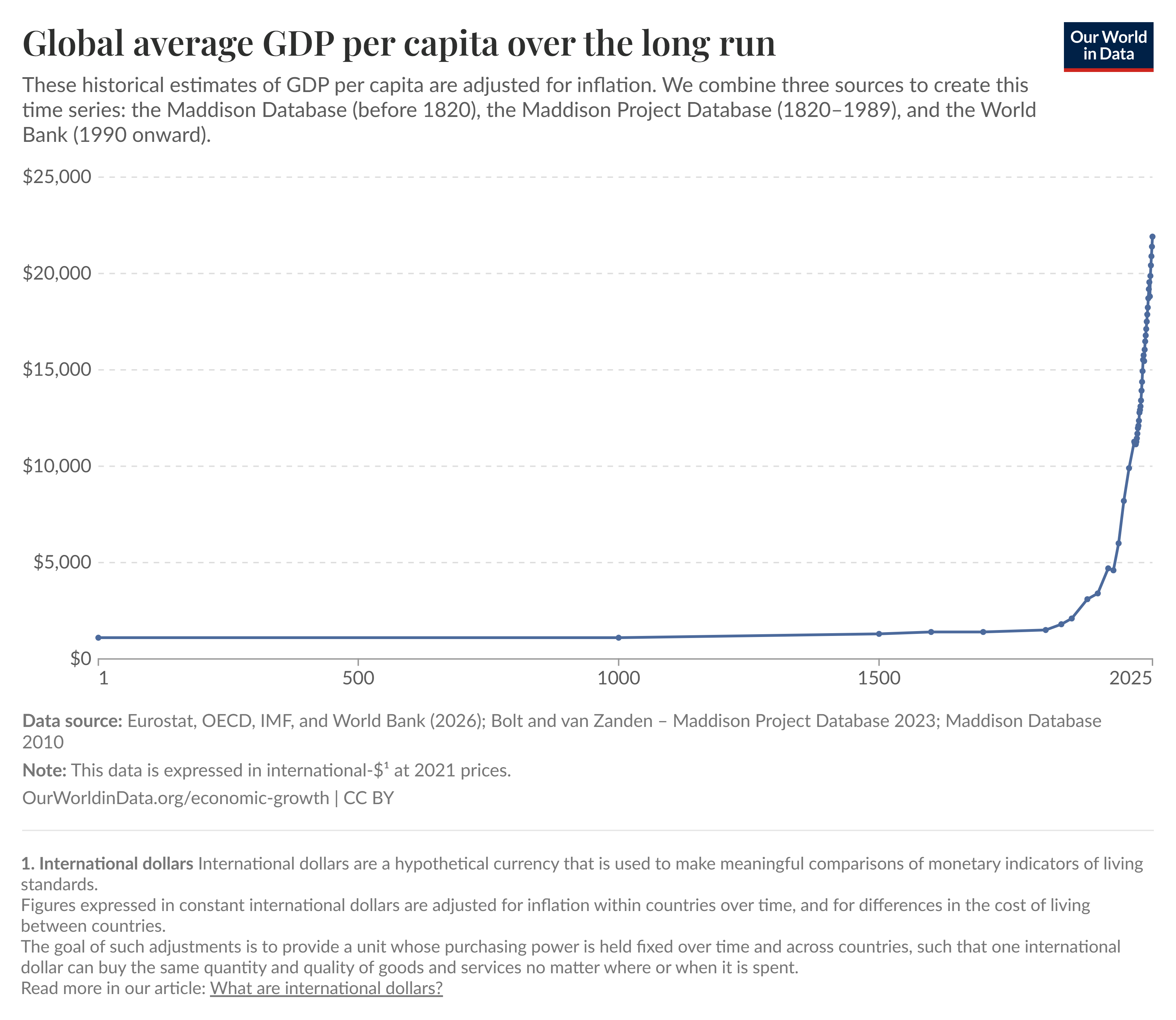
Adam Smith, Friedrich Hayek, and Julian Simon were right that vast swaths of economically relevant knowledge had yet to be discovered. And their insights are still true today. That hockey stick graph can keep going up because humans, and now AI, can keep discovering new knowledge, advancing science and technology, and revealing economic knowledge through market production and exchange unboundedly into the future.