

Last month I argued that “the discovery of economic ignorance” was a key insight that came out of the Enlightenment and paved the way for modern prosperity.
I focused on the ideas of Adam Smith because he played a central role in advancing the Enlightenment conception of economics. In short, that is the notion (among other things) that economic progress entails primarily the decentralized discovery and aggregation of local knowledge. That conception contrasts sharply with the pre-Enlightenment view that infallible divine authorities or their human representatives possess essentially complete knowledge of how the economy should be organized.
But Smith’s ideas built upon other brilliant thinkers in the Enlightenment movement. It was not just one man but a broader intellectual community that gave us this paradigm shift into modern economics.
Richard Cantillon is one such important figure. An Irish banker, merchant, and adventurer, he penned revolutionary accounts of how private enterprise reveals economic information that would otherwise be unknown to anyone.
For example, in his Essay on the Nature of Trade in General, published posthumously in 1755, Cantillon writes (as translated by Antoin E. Murphy):
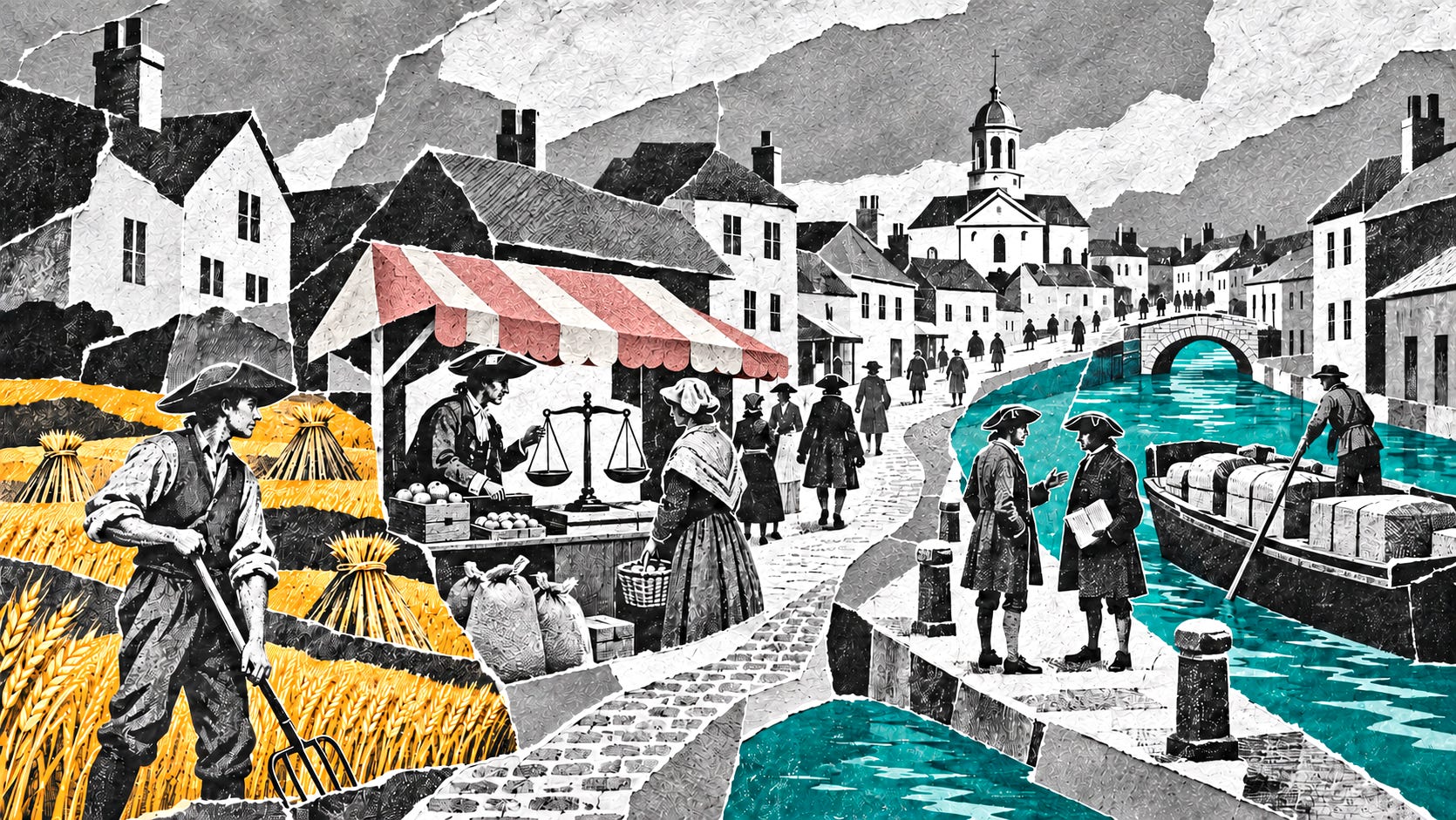
The farmer is an entrepreneur who, without any certainty about what advantages he will derive from the enterprise, promises to pay the owner a fixed sum of money for his farm or land—which is normally assumed to be equal in value to a third of the land’s produce. Relying on his judgment, and not knowing which of the products will obtain the best price, he will farm part of the land to raise flocks, produce grain, wine, hay, and so forth. The price of these products will be partially dependent on the seasons and will partially depend on consumption. If wheat is plentiful relative to its consumption, it will be at a very low price; a shortage of it will lead to a high price. Is there someone who can predict the annual number of births and deaths in a state? Is there someone who can predict the growth or fall in households’ expenditures? The farmer’s prices for his commodities, however, naturally depend on these unpredictable events. Consequently he manages his farm’s business in circumstances that are uncertain.
Cantillon’s farmer has to decide what to grow before he knows what his crops will fetch. In the next chapter, Cantillon imagines a landowner who dismisses some of his servants and keeps more horses. Demand for wheat falls and demand for hay rises. As wheat gets cheaper and hay gets dearer, farmers sow less wheat and devote more land to hay. The change in prices gives them a reason to change what they grow, even if they never hear about the landowner’s decision.
Together, these examples show how markets dynamically respond to the ever-changing and unknown conditions of the real world through the free choices of individuals. This account runs counter to the pre-Enlightenment notion mentioned above that economic tradition and paternalistic mandate were eternal and infallible.
While the precise extent of the influence is unclear, we know that Adam Smith was influenced by Cantillon. Smith mentions him by name in I.viii.15 of The Wealth of Nations, which was published in 1776, 21 years after Essay on the Nature of trade in General.
Similarly, Smith was plausibly influenced by Anne Robert Jacques Turgot, with whom he reportedly discussed commercial theory, public credit, and banking a decade prior to the publication of The Wealth of Nations.
Turgot was a French philosopher and economist who served as administrator under Louis XV and comptroller general of finance under Louis XVI. He was for a time considered France’s foremost thinker on progress, and his ideas about the role of local knowledge in economics were fleshed out as early as 1759.
In that year he wrote of “the complete impossibility of directing, by invariant rules and by continuous inspection a multitude of transactions which by their immensity alone could not be fully known, and which, moreover, are continually dependent on a multitude of ever changing circumstances which cannot be managed or even foreseen.”
That is from his essay “In Praise of Gournay” (as translated by Peter D. Groenewegen). In that same essay Turgot wrote:
To imagine that the State should encourage the earth to bring forth one kind of produce rather than another, that it ought to establish certain types of manufactures rather than some others; that consequently it ought to prohibit the production of some goods and order that of others; to forbid certain kinds of industry for fear of injuring other kinds; to claim to sustain manufacturing, when it is at the expense of agriculture by forcibly maintaining the price of provisions below their natural level; to establish certain manufactures at the expense of the Treasury; to heap privileges on them, favors, exclusions of all manufactures of the same kind for the purpose of procuring for the manufacturers a profit which it is assumed they could not obtain by the natural sale of their products: all this is to misunderstand greatly the true advantages of commerce; it is to forget that no commercial transaction can be anything other than reciprocal, and that, therefore, the desire to sell everything to the foreigners and to buy nothing from them, is absurd.
There is no need to prove that each individual is the only competent judge of this most advantageous use of his lands and of his labor. He alone has the particular knowledge without which the most enlightened man could only argue blindly. He alone has an experience which is all the more reliable since it is limited to a single object. He learns by repeated trials, by his successes, by his losses, and he acquires a feeling for it which is much more ingenious than the theoretical knowledge of the indifferent observer because it is stimulated by want.
These passages suggest that Turgot had lost any pre-modern faith in the authorities of political monarchs and bureaucrats to organize his nation’s economy, and that his trust had already been placed in the individuals of private industry and enterprise to make decisions about their own private property.
Adam Smith probably did more than anyone of his era to popularize these radical ideas, and he made many important intellectual contributions of his own. Moreover, The Wealth of Nations is probably the best single document that encapsulates this Enlightenment tradition of free-market economics. But many great thinkers of that period had pierced through the illusion of infallible economic authority. They all helped lay the groundwork of modern free-market economics, which remains among the most liberating and illuminating intellectual traditions of our age.